What is special about elephant teeth?
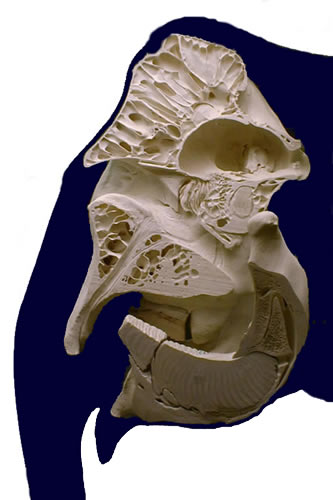
In contrast to humans, elephants are lucky enough to undergo further dentition 6 times. Teeth are not, however, exchanged from the bottom to the top (vertically), as in humans and most mammals, but rather from the back to the front (horizontally). Elephant calves are born with approximately 2 small molar teeth, about the size of a thumbnail, in both the upper and the lower jaw. In the course of time the molar tooth next in size slowly moves from the back to the front and thus replaces the old tooth. Also have a look to the skull.
What have the teeth got to do with an elephants graveyard?
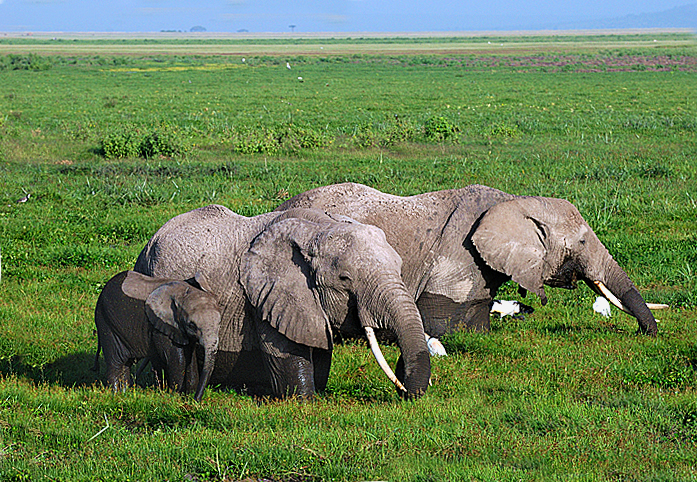
When the last tooth is worn down, it becomes difficult for elephants to chew their food properly, and then they usually start to look around for softer vegetation, which grows in the swamps. In the end, however, old elephants succumb to their weakness and die at the water’s edge.
Old elephants’ inclination to die in one and the same area has enabled the rise of the fairy tale and myth of the elephant’s graveyard.
How are the teeth built up?
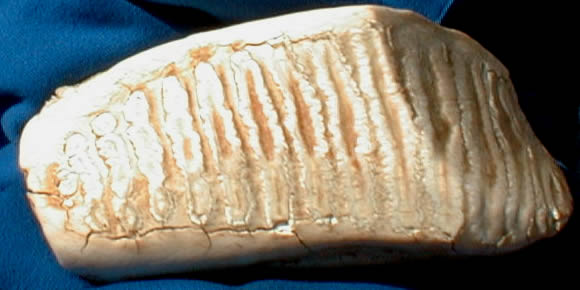
Elephants’ molar teeth are like lamella. Through eating and chewing an old and worn down lamella breaks off in due course and falls out of the mouth or is swallowed. Molar teeth M5 and M6 are the size of bricks.
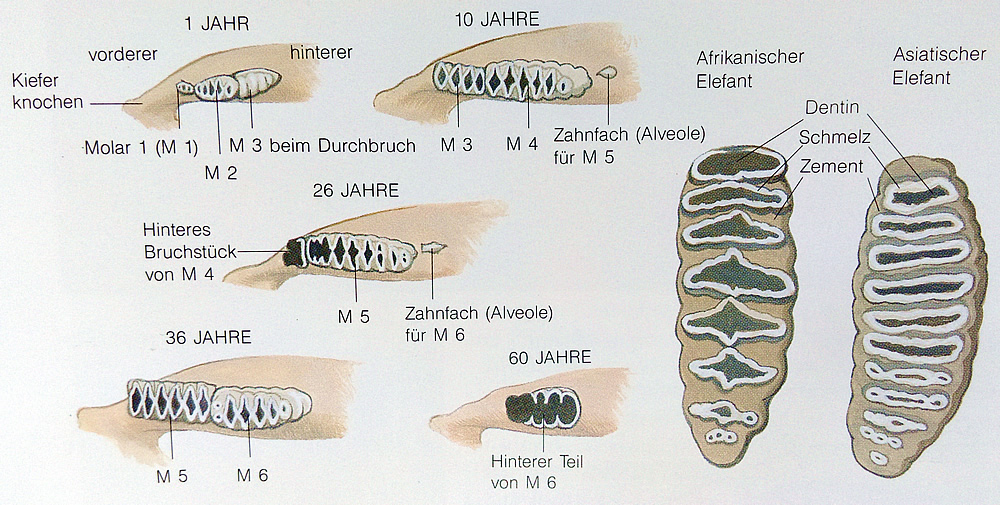
They are differences lamella profiles by the asian and african elephants.

What are tusks?
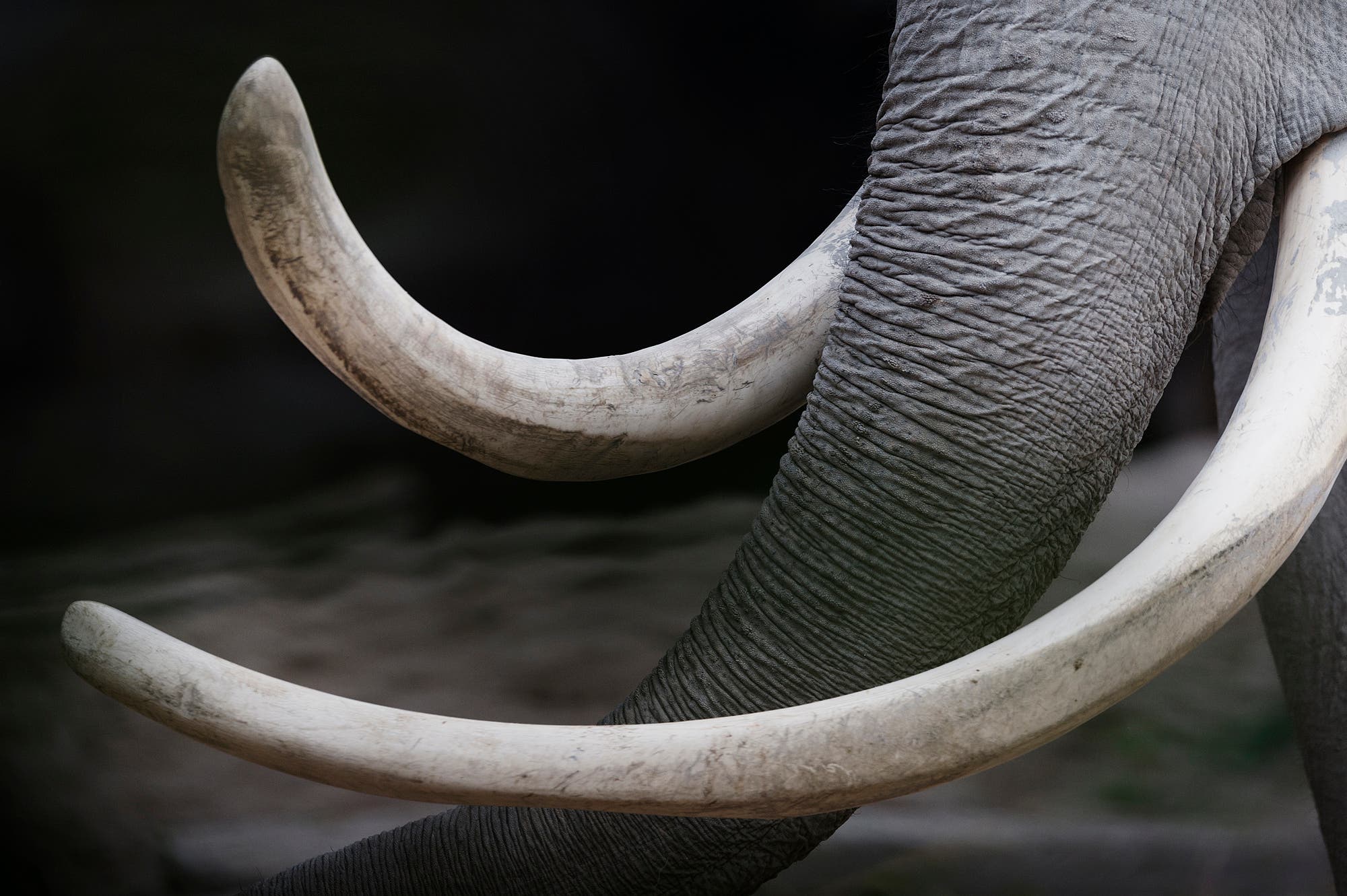
Elephants’ tusks correspond to other mammals’ incisor teeth. One of the tusk’s unique characteristics is that it does not have a coat of dental enamel.

Elephant calves‘ tusks break through when they are approximately 1 year old. When they break through, tusks still have a coat of dental enamel. This coat of dental enamel is rubbed off when the teeth are used, so that tusks consists largely of dentine.
Normally, around two thirds of a tusk is visible. The first third is lodged in the skull’s tooth socket. Two thirds of the tusk are ‘alive’. This means that they have pulp cavities which are filled with a tissue which has an abundance of blood vessels and branches of nerves. This is why tusks are sensitive to pressure and blows.

A tusk breaking off can have disastrous consequences for the elephant concerned. In the worst case the odontic nerve, the pulp, is exposed and the animal dies of the enormous pain.
How do the teeth of the African and Asian elephants differ?
In the Asian elephant, only about half of bulls have tusks, in contrast to African elephants, where both sexes have large and very visible tusks. Female Asian elephants only have thin, short tusks (Nuggets), which break off in fights or under too great a strain, however, and do not grow anymore.

What is a tusker, what is a makna?
Bulls with tusks are called “tuskers”. Bulls without tusks are called “Makna” or “Mukna”. Maknas have a reputation for being more dangerous and cunning than tuskers amongst elephant handlers. Maknas are recognisable only by their bull-like build. From a distance they can be mistaken for cows. That is why most zoos or circuses which have an elephant bull have and present a tusker in their stables. Zoo and circus directors like to show off with their elephant bulls.

What do elephants need tusks for?
Tusks are indispensable multi-purpose tools. They are necessary when digging for water, salt and roots, when removing the rind from trees and as levers for moving branches and trees. Working elephants use their tusks to lift tree trunks for example. They are also displayed to impress, are used to mark trees and as weapons in battle.
How heavy is a tusk?
We were able to establish the weight of tusks a few years ago, as a piece of Maxie’s tusk broke off. The piece that broke off was 70 centimeters long and weighed 7 kilograms. Hence 10 centimeters of tusk weigh around 1 kilogram.

What is a ‘master tusk’?
Just as there are left-handed and right-handed humans, thus elephants also have their preferences. There are left-tusked and right-tusked elephants. The preferred tusk is called the master tusk.

