How do elephants communicate?
Since elephants are not “loners”, but live in a herds, they need several possibilities of communicating with each other. The trunk, the ears, the tail, body language and naturally also the voice are some of these means of communication. The eyes and the sense of sight of the elephants, however, in relation to the sense of smell and touch, rather bad.
What does the position of the trunk mean?
The trunk‘s position can either be defensive or threatening.
Elephants can also touch and smell with the trunk, however. Thus they notice where the other elephant has just been, what it ate and how it feels.

How do elephants smell things?
An elephant bull will establish whether an elephant cow is in heat with his sense of smell, for example.
As elephants have an active vomeronasal organ (VNO), or the Jacobson’s organ (organum vomeronasale), just as reptiles do, they are capable of sensing and analysing small concentrations of odorous substances in the air.
Why do elephants flap their ears?
Flapping the ears can express excitement and joy. In turn, the beating of the ears on the skin can be heard. This sound causes other elephants to prick up their ears and to get in contact with the first elephant.
In hot weather, elephants use their ears primarily to cool down, however.
What does the tail have to do with communication?
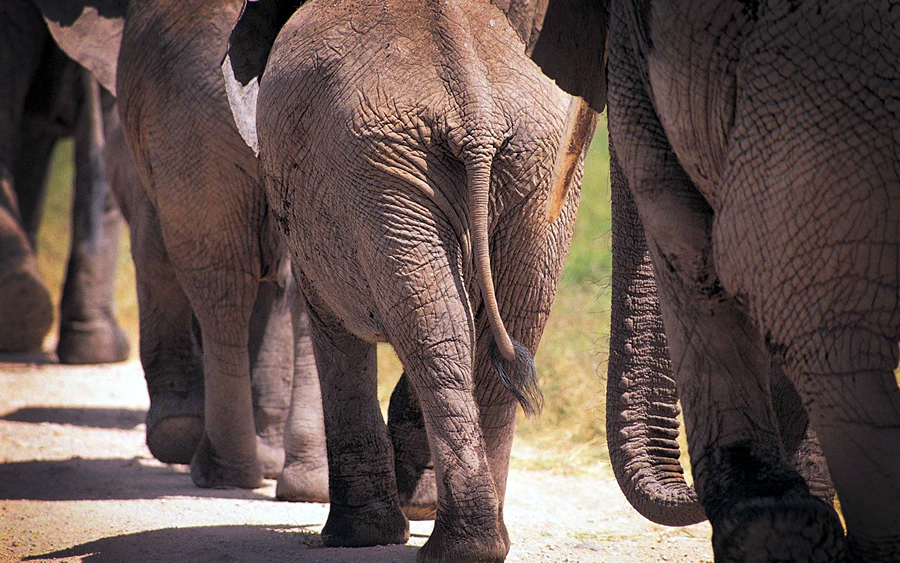
At the back, the tail often serves as a sensory touch instrument. Elephants probe those surroundings which are outside their direct vision with it. That is how they ensure that they have all the necessary information concerning their distance from other members of the group and the immediate environment.
Elephants can also hear with their feet
Despite their large ears, African elephants still use a another “hearing organ”: her feet. As US researchers reported in the British scientific magazine “New Scientist“, they can use it to pick up alarm signals from other herds. Elephants are known to communicate over kilometres,
by generating low-frequency sounds. Researchers at Stanford University in California suspect that the sounds are spreading across the ground.
and can be absorbed by the sensitive feet of the animals.
How important is an elephant’s voice and its hearing?
Using both their voice and their hearing, elephants can communicate with each other over great distances.
Fellow elephants who know each other greet each other with quiet rumbling or purring which reminds one of a running diesel engine. Calves bellow loudly for their mothers when they feel lost. Anxious, attacking and attacked elephants trumpet.
What is infrasound?
It is also known that elephants converse over great distances using infrasound. Human beings can’t hear these low-frequency sounds.
Human ears can hear sounds in the range from 20 to 20’000 hertz. Elephants, however, can also emit sounds in the range of 14 – 24 hertz, at a volume of between 85 and 90 decibels. This is significantly louder than the noise level which human conversation generates, namely around 65 decibels.
With such energy-laden sound waves, elephants can communicate with each other up to a distance of severel kilometres.
Is infrasound important?
Researchers at the University of Sussex in Brighton and the Amboseli Elephant Research Project have found out, however, that this does not appear to be so important for elephants (‘Animal Behaviour’, Vol. 65, p. 317).
Their contact calls to relatives or friendly herds over great distances contain the most important information in a range that we can hear too. Elephants can thus recognise up to 100 individuals by their voices.
The maximum range of the relevant information in such a social call is a mere 2.5 km, however. Up until now it was assumed that elephants exchanged information over distances of up to 10 kilometres.
The biologists observed 1700 elephants in Amboseli National Park, Kenya, for years and recorded the animals’ voices. In playback experiments, the elephants reacted to recordings of well-know fellow elephants by sniffing the air with their trunks, giving an answer and moving towards the loud speaker.
The researchers assume that the infrasound frequencies are simply created in elephants’ larynxes on account of the animals’ size and that they are not used for communication. The trunk, which can amplify audible sounds, is said to be more important for ‘long distance calls’.
Amazing sounds as the herd of female elephants are introduced to Upali, the bull elephant, for the first time at Dublin Zoo.
What do elephant voices sound like?
As elephants are basically very quiet animals, it was not easy to record their voices. Elephants often respond to unusual events with bellowing and squeaking, however. In this case the unusual event was an elephant handler dancing a ‘rock and roll’ dance with the wheel barrow.
Chhukha flap their ears
Chhukha and a bird
Chhukha and Druk
Chhukha and Druk
Druk
Chhukha
Bull Maxie still knows the command ‘speak’ from his earlier circus life. He very much likes carrying out this command, as he immediately receives a juicy morsel into his open mouth after doing as he was told.
Recordings by: www.cadruvi.com

