How is a skeleton built up?
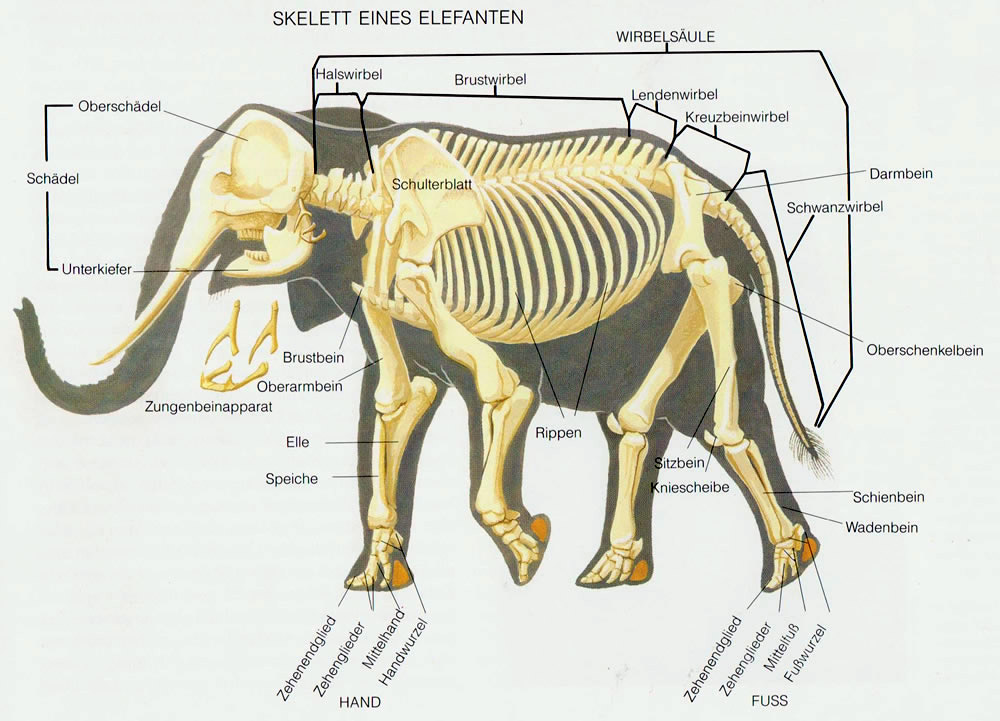
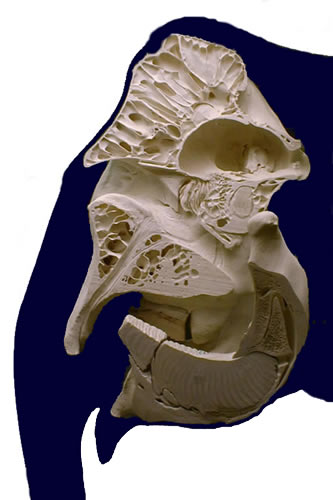
As for all mammals the elephant’s skeleton is made up of skull, spinal column, extremities, ribs and breastbone. Since the different elephant species have different numbers of thoracic, lumbar, sacral and caudal vertebrae, an elephant’s skeleton consists of 326 to 351 bones. Elephants walk on the tips of their fingers and on the tips of their toes.
How many muscles does an elephant have?
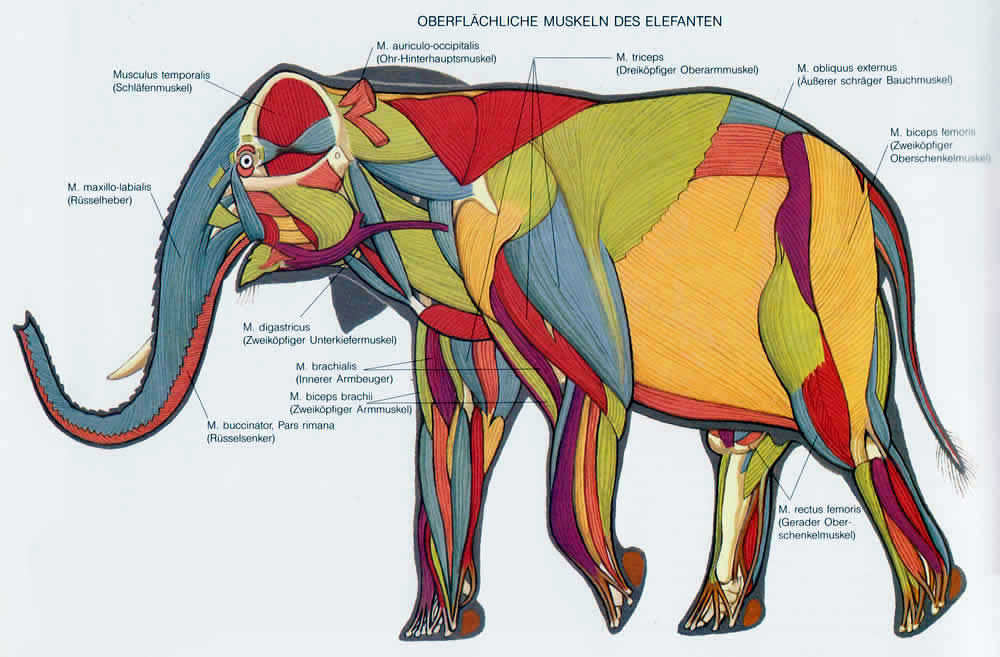
Approximately 394 different skeleton muscles set the elephant’s body in motion.
The most remarkable part of the elephant’s body is the trunk. The trunk consists of about 40,000 individual muscles. They give it a remarkable flexibility and deftness.
How big are the internal organs of an elephant?


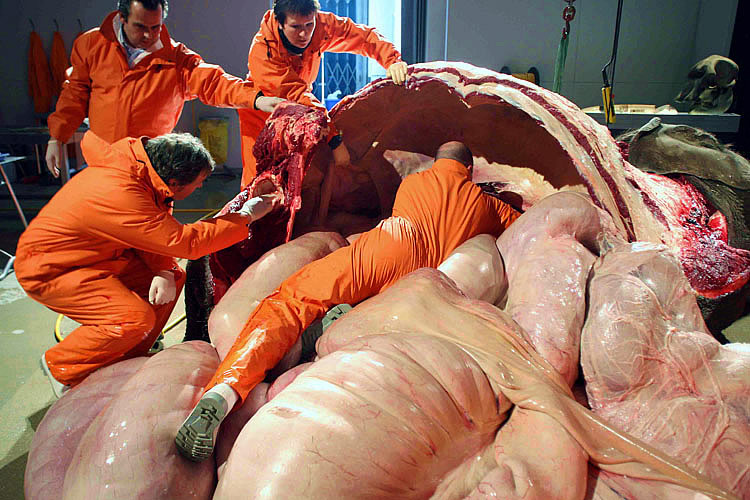
The internal organs of the elephant are proportionately not bigger than with other mammals. The brain weighs about 4.5 to 5.5 kg, the heart – depending on the age – between 12 and 21 kg.
How big is the heart?
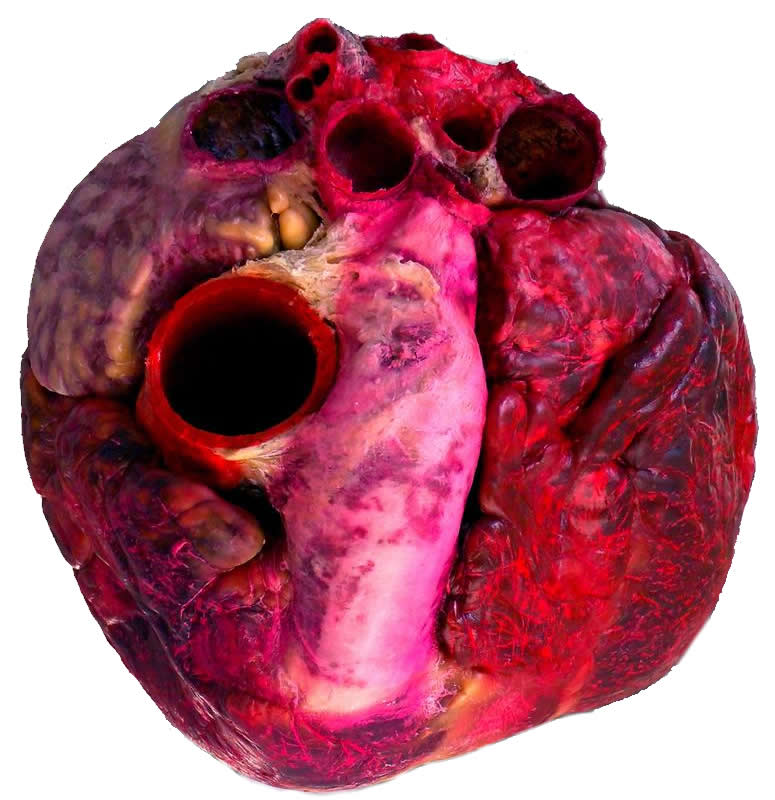
The heart beats approximately 30 times per minute.
The quantity of the blood corresponds to about 10 % of the body weight.
The body temperature of a healthy elephants is about 35.9 degrees.
Where are the elephant bull’s testicles?
The elephant bull’s testicles are inside the body, near the kidneys.
 More about the evolution of the testicles and puzzles about the location of the male sex organs in mammals:
//www.mpg.de/12113822/testes-evolution
Are elephants “thick skinned”?
ll the muscles, organs and bones are held together by a strong and “thick” skin. The expression “thick skinned” is still not quite right for elephants, however.
Where are an elephant cow’s teats?
The teats of an elephant cow, unlike those of most other mammals, are situated between her front legs, as is also the case in humans, primates and whales.
To enable the calf to have a soft landing as it enters the world, the mother’s vaginal opening isn’t below the base of her tail but between her hind legs. This reduces the drop for the newborn elephant from around 170 cm to only 70 cm.
As a result, there is no more space for the mammaries between the hind legs, which is why, in the course of evolution, the lacteal glands and teats of female elephants have shifted forward to their current position, i.e. between the elephant cow’s front legs.
The anatomically closest relative of the elephants is the Hyrax!


How many teats does a female elephant have?
The number of teats in mammals is adapted to the average litter size.
As a general rule of thumb, the number of teats corresponds to the average number of young animals times two.
Mammals, which on average only have one young, like elephants, therefore have only two stations at the milk bar.
Awesome photos.
Humans, whales, and chimps do not have front legs.
Thank you for the compliment to the pictures!
For your statement that humans, whales and primates do not have front legs, I would like to refer you to the theory of evolution. Over the millions of years of evolution, certain mammals, such as the apes or primitive humans, began to walk on their hind legs. The forelegs developed into arms with hands and fingers as gripping tools. Even the ancestors of the whales once lived in the countryside. From the forearms and fingers developed over thousands of years their huge fins. For this reason one can say that the forearms are a further development of the forelegs.
Hello!
May I ask about the source of the pictures – especially the muscle scheme? It would be awesome to have this picture as a painting on a wall 🙂 Thank you.
Hello Martin
The pictures are taken from the book “Enzyklopädie der Tierwelt – Elefanten Jahr-Verlag Hamburg ISBN 3-291789-94-x”. Unfortunately the book has not been available for years.Enzyklopädie der Tierwelt – Elefanten Jahr-Verlag Hamburg ISBN 3-291789-94-x
cool
Why does the elephant, rhino and hippo all have these unique thoracic spiny protrusions? Every part of their anatomy seems to have a specific reason or use but after many hours of research I can’t find any theory’s on why the elephants spine is shaped the way it is.
Those are called thoracic vertebrae neural spines and almost all mammals have them but they are exaggerated in animals that need a substantial amount of muscle mass. All of the animals you listed are heavy and moving limbs takes a lot of strength, the more surface a bone has, the heavier it is but that means theres more room for muscles to attach to bone.
Hello, Robyn Barker.
You mean the extension to the sternum?
To be honest, I’ve never noticed that before.
You can also see this extension on some old pictures.
I’m sorry, but I don’t know the answer either. If you find an answer, I would be very interested.
Perhaps someone else knows an answer to this question!
I’m curious about that too but no I mean the bony protrusions that come off the spine. They are like small fingers of bone that stick up from the spine all the way down the thoracic section. Hippos and rhino have them too. It’s the main reason why elephants should never be ridden or be forced to carry weight on their backs. But I’m really curious as to why their spines are formed this way.
Generally protrusions from the spine are for muscle or ligament attachment. There are some muscles in the image of the musculature that could attach to these spines.
However, I think these protrustions serve mostly as attachment for the ligamentum nuchae. This is a ligament that helps tetrapod animals, like deer or cows etcetera to relieve them of the weight of the head, which is not carried by their skeleton as in humans. Since elephants have pretty heavy heads, I guess this is why they need such large protrusions all the way down their spine for this ligament to help them.
For another example of extreme spinal protrusions, google ‘Irish Elk’ and look at their spines. These animals had huge antlers, which could weigh up to 40 kilograms, so they needed a lot of support as well.
I am an elephant biologist. I am really impressed with the contents you have uploaded. It would have been nice if you could also write similar blog on Asian elephants
Do you have a suggested book to study African/Asian elephants.